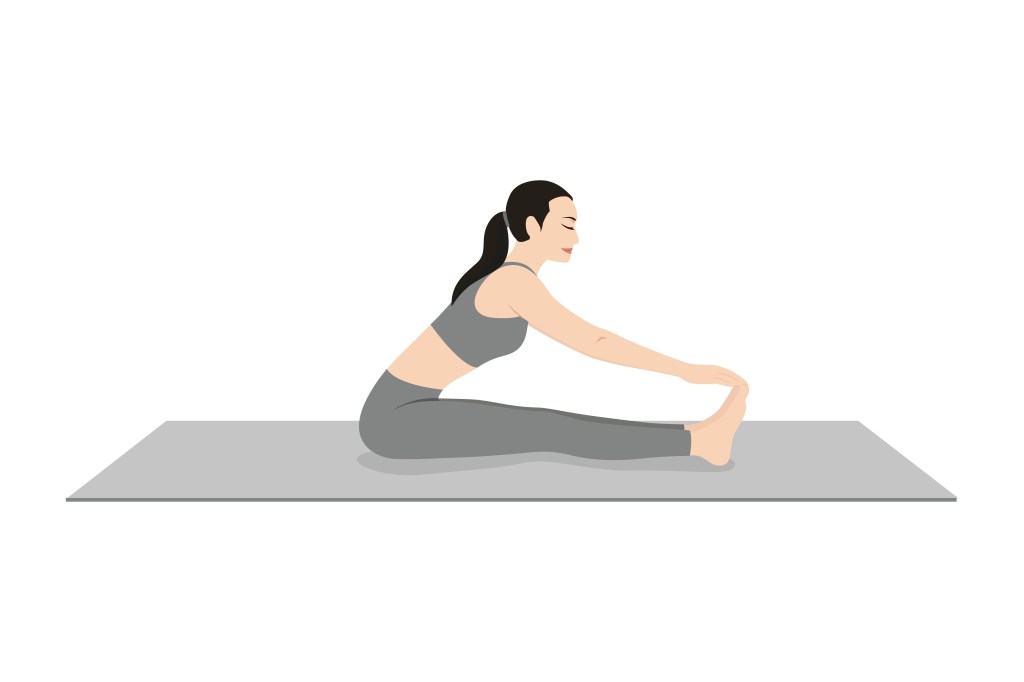
I think there’s a lovely introspective quality to paschimottanasana or our seated forward fold in yoga. It feels nurturing, turning awareness inward as you, quite literally, fold in on yourself physically. This asana has soothing, calming and rejuvenating properties. The idea is that the whole of the back of the body is stretched – all the muscles in the backs of the legs and the trunk, and fascia from the plantar fascia at the soles of the feet to the scalp fascia. Other apt names for this pose are posterior and back stretch. In addition you get a massage of your abdominal organs.
It’s good to settle yourself into dandasana or base pose as the starting point, and to think about protecting your low back as you prepare. Make sure you’re on your sit bones, elevating them a little on a folded blanket or cushion to create a forward tilt for your pelvis, and if your hamstrings feel tight it’s absolutely fine to have a bit of a bend in your knees. In this pose remember the point of it. That stretch all along the back of the body. That’s the desired outcome.
So you want to feel tall in the spine. Invite your spine to lengthen as you inhale. I like to accompany this by reaching arms skywards and then, hinging at the hips, keeping that tall spine, drawing my belly towards my thighs on an exhalation as I fold forwards. It can be good to flow in and out of paschimottanasana like this a few times before settling in. Remember each time to keep that length in a neutral spine with the natural curves intact and your neck and head in line with the rest of your spine. You’re aiming to gently encourage your tummy towards your thighs, rather than your head to your knees. Let your hands find a comfortable position by your sides, on thighs or lower on your legs, or perhaps you can catch your feet.
Once you’re in place you can work yourself a little deeper with your breath, if that’s available. Try lengthening the spine as you inhale into the top of your lungs, and exhaling from your tummy as you draw it a little closer to your thighs. You want your legs to be in neutral rather than rotating outwards or inwards. Let gravity and exhalation guide you further in. Then just be here for a while feeling the lengthening along the back of your body, the way your spine gently oscillates with each breath, and maybe closing your eyes.
If your trunk is lying along your legs in the full expression of the pose, you might like to invite a soft rounding into your spine and neck. Most people don’t have their bodies flat against their legs so there is scope to work towards this. In the meantime I think it’s good practice to keep your neck and head in line with the rest of your spine as in the illustration.
You could have a play and try coming into paschimottanasana a different way. With knees bent in close to your body and feet on your mat, link your arms around the backs of your thighs, with your abdomen on your thighs and your chest on your knees, and then slide your feet away from you. Rotate from the hips and keep your thighs and trunk firmly glued together. At the point at which they are parting company, hold the position in your spine and let your legs straighten to the extent that works for you.
An interesting guideline as to how close you can expect to fold forwards in this asana is to lie on your back, placing a strap around the balls of your feet (a dressing gown tie can be a good substitute for a yoga strap), and then gently encourage your thighs to your tummy. Your spine’s supported by the earth in a neutral position. Keep the whole of your trunk on the mat as you draw your thighs towards you.
Enjoy…
Best to check with your health care professional before practicing yoga. I share yoga in beautiful Tasman Bay near Nelson, New Zealand. Please contact me for more information about weekly group sessions, private sessions, workshops and to book.
 Sue Ransom Yoga
Leave a comment